
This guide is for learners in England (school leavers, apprentices, and adults changing careers).
The quickest way to make sense of “how to become a welder” is to separate three things:
- The job itself (what welders do day to day)
- The route you take (apprenticeship, college, training provider, or direct entry)
- The evidence you build (safe working, consistent weld quality, and recorded competence)
Welder roles and training vary by industry, employer, and the welding processes used.
This guide covers becoming a welder, not coded welding (coded welding is a separate, more specialised route and is not covered in this careers guide).
In other words, this page explains how people usually start a welding career in England and build the training, experience, and evidence needed to work as a welder.
What is a welder?
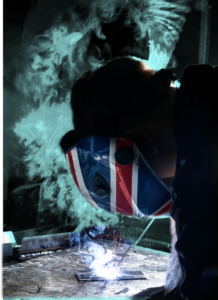
A welder is someone who cuts, joins, and shapes metals (and similar materials) for manufacturing, construction, and engineering work.
In practice, welding is used to create and repair parts and structures by forming strong joints that meet a required standard. Welding work is also safety-critical in many settings because poor weld quality can lead to failures.
What does a welder do?
Welding is not just “running a bead”. The role usually includes preparation, set-up, joining, and inspection.
Common day-to-day tasks include:
- Following drawings and instructions
- Preparing the materials to be joined and selecting an appropriate welding procedure
- Setting up and operating welding equipment
- Inspecting and testing the quality of joins using measuring instruments
- Dismantling and cutting up metalwork (for example, in demolition work)
Welders may also have their work checked using visual inspection, dimensional checks, and sometimes more formal testing methods (which can include non-destructive and destructive testing, depending on the job).
Table of Contents

What industries can a welder work in?
In England, welding jobs exist anywhere that metal components are manufactured, installed, maintained, or repaired.
At a high level, welders work across:
- Manufacturing
- Construction
- Engineering industries
Examples of sectors and work settings (these vary by employer and site):
- Fabrication shops and factories
- Assembly yards
- Construction and building sites
- Operational facilities doing maintenance and upgrade work
Some employers and programmes also reference industries such as aerospace, marine, structural engineering, defence, and mining as places welders may be employed.
How do I become a welder in England? Training routes explained

There are several legitimate routes into welding, but they do not all lead to the same level of qualification or recognised competence. The best one depends on your starting point (age, qualifications, work situation), your budget, and how quickly you want to move into paid work.
The National Careers Service lists common routes into welding as:
- A college course
- An apprenticeship
- Applying directly (or put forward by your company)
- Specialist courses run by a private training provider
Below is what that usually means in England, in practical terms.
Which welding route might suit me best?
- Apprenticeship: best if you want paid work, structured training, and a clear route into industry.
- College course: best if you want to build core skills before applying for junior roles or apprenticeships.
- Specialist training provider: best if you want shorter, focused practical training in specific processes or workshop basics.
- Applying directly: best suited to people who already have relevant experience, transferable engineering skills, or employer-recognised evidence.
- Company puts forward for NVQ: best if you are already working for a company that carries out welding and want to gain a full, work-based qualification (typically Level 2 or Level 3 NVQ).
The right route depends on your age, location, budget, experience, and whether you want to move straight into paid employment or build skills first.
Pathway one: welding apprenticeship in England

An apprenticeship is a paid job with training. In England, GOV.UK explains that to start an apprenticeship you must be 16 or over, living in England, and not in full-time education.
You can search and apply for apprenticeship vacancies through the Find an apprenticeship service (England).
What the apprenticeship experience typically includes (England):
- You work and get paid during the apprenticeship
- You get time for training/study
- You have normal employee rights (for example, holiday pay)
Off-the-job training matters. In England, apprentices must spend at least 20% of their normal working hours on training.
What is “EPA” and what is “gateway”?
- End-point assessment (EPA) tests the knowledge, skills and behaviours you have gained during training.
- “Gateway” is the stage before the EPA starts when you, your employer, and your training provider decide you are ready to progress; the assessment plan sets out what must be in place at gateway.
Pathway two: college welding qualifications

A college route usually means you complete a welding qualification (or an engineering programme that includes welding) and then apply for trainee/junior roles.
The National Careers Service gives examples of college course types such as:
- Welding skills
- Welding techniques and skills
- Fabrication and welding engineering
- A T Level in Engineering, Manufacturing, Processing and Control
Entry requirements vary by course and provider.
Pathway three: specialist welding courses with a training provider
Private training providers often offer short, intensive welding programmes (for example, to build foundation skills or to add a process such as MIG, TIG, or MMA). The National Careers Service lists specialist courses run by a private training provider as one route into welding.
Because course formats vary, it helps to be clear about the outcome you need. A short course can be useful if you need supervised practice, structured workshop time, and a starting set of safe-working habits. For example, training-provider welding course descriptions commonly cover workshop safety, PPE, and safe set-up/operation of welding equipment, alongside supervised practice and basic inspection.
However, short courses do not always lead to a recognised qualification. In many cases, you may receive a certificate of attendance rather than an awarding body qualification required to demonstrate full competence as a welder.
Pathway four: applying directly

Some people move into welding by applying for roles and building evidence through related work (or by starting in an adjacent role and progressing).
The National Careers Service notes that if you apply directly you will typically need welding experience and certifications, and it gives examples of relevant backgrounds such as pipe fitting, engineering construction, marine engineering, and steel fabrication.
In practical terms, employers also tend to value evidence that you can work safely, follow instructions and drawings, pay attention to detail, and produce consistent work to the required standard. For entry-level roles, this can come from training records, supervised workshop experience, previous engineering work, or an apprenticeship route.
Pathway five: NVQ – work-based qualification

An NVQ (National Vocational Qualification) is a work-based route that demonstrates occupational competence as a welder against recognised industry standards. You are assessed while carrying out real work tasks, building a portfolio of evidence (such as completed welds, observations, and assessor feedback).
Training and assessment can be delivered in the workplace or through a training provider, and programmes can take up to 24 months depending on your experience and employer requirements.
Unlike short courses, NVQs lead to a recognised awarding body qualification (for example, City & Guilds or EAL). However, some roles may still require additional welding qualifications, such as passing specific coding tests to industry standards.
Becoming a welder with Elevated Knowledge
This route is designed for learners who want to train in a workplace-based apprenticeship structure, with employer-led work, planned training time, and an end-point assessment model. The exact work you do and the welding processes you use will depend on your employer’s environment and the standard requirements. See the Elevated Knowledge’s Level 2 General Welder course page for full details.
- Level: Level 2
- Delivery: In person (Stockport)
- Typical duration to gateway: 18 months
- Typical EPA period: 3 months
This timing is typical based on Skills England standard summary for the Level 2 Welder standard (ST0349) and associated EPA information.
What it covers:
- Producing welds using manual and mechanised arc welding processes
- Welding using a minimum of two weld process and material combinations, with at least one manual process
- Producing welds in components covering two welding positions, in at least two joint layouts
Why become a welder?
People choose welding for different reasons, but the practical planning questions tend to be similar:
- What might I earn? The National Careers Service salary range for welders: £25,000 (starter) to £45,000 (experienced).
- How long does it take? For the Level 2 Welder apprenticeship standard (ST0349), Skills England show a typical duration to gateway of 18 months, followed by a typical EPA period of 3 months.
- What are the working hours? Typical working hours noted by National Careers Service: 40 to 46 hours per week, with the possibility of evenings/weekends/shifts.
- What are the working conditions? Working environment can change significantly by job. National Careers Service notes welding can be in workshops, on construction sites, or on demolition sites, and that conditions may be hot, cramped, and at height, with safety clothing/equipment needed.
What happens after I’ve become a qualified welder?
After initial training, progression usually comes from three things: time on the job, exposure to different materials and processes, and evidence of consistent quality and safe working.
The National Careers Service progression examples include moving into supervisory and inspection-related work. In practical terms, welders may also specialise over time depending on the industry, materials, and types of fabrication they work on.
Examples of progression and specialisation can include:
- Fabrication welding and heavier structural work
- Pipe or tube welding in sectors that need process pipework or similar systems
- Coded welding or other employer-required welding qualifications against specific standards
- Welding inspection, non-destructive testing, or quality control
- Supervisor roles, workshop management, or team-leading responsibilities
- Further training routes, including teaching or instructor roles later on
Depending on the employer and sector, welders may work across manufacturing, construction, structural engineering, marine or shipyard environments, rail-related engineering, and energy or other industrial settings. Progression can lead into more senior technical roles or specialist inspection positions.
What you’ll learn (learning outcomes)
Learning outcomes depend on the route and standard, but the common thread is building repeatable competence: safe set-up, controlled execution, and inspection/quality awareness.
Examples of learning content and outcomes aligned to the Level 2 General Welder include:
- Conducting safety checks of welding equipment and the work area
- Reading welding data and technical documentation, including engineering drawings and job instructions
- Identifying and checking materials before welding and confirming they meet quality requirements
- Preparing joints and setting up equipment so work can be completed safely and consistently
- Producing welds in different positions and joint types using relevant arc welding processes
- Recognising common weld quality issues and understanding how visual inspection and dimensional checking are used
- Working to quality and safety requirements as part of normal engineering practice
Where an apprenticeship end-point assessment is involved, Skills England notes that gateway evidence can include workplace records and other proof that you have welded materials in different positions (including the positions assessed at EPA), and that welding certificates must be issued by a recognised third-party organisation and cover the processes used at EPA.
Pay and progression as a professional welder

This section separates two topics that often get mixed together:
- Apprentice pay rules (legal minimums)
- Typical pay for qualified welders (labour market information)
Apprentice pay rules in England
Current National Minimum Wage / National Living Wage rates shown on the GOV.UK minimum wage guide:
- From April 2025: apprentice rate £7.55 per hour (and age-banded rates for others).
- From April 2026: apprentice rate £8.00 per hour (and updated age-banded rates).
- In England, apprentices are entitled to at least the apprentice rate of the National Minimum Wage if they are under 19, or 19+ and in the first year of their apprenticeship.
- If an apprentice is 19+ and has completed the first year, they are entitled to the National Minimum Wage (or National Living Wage) rate for their age.
- Apprentices must be paid for normal working hours and for training that is part of the apprenticeship (including the minimum 20% off-the-job training).
Typical pay and hours for welders
National Careers Service lists the what to expect for pay and hours as:
- Salary: £25,000 starter to £45,000 experienced
- Typical hours: 40 to 46 hours a week, and may include shifts/evenings/weekends
Treat pay as variable. It can change with location in England, shift patterns, overtime arrangements, and the type of welding work (for example, workshop fabrication versus site work).

Frequently asked questions
What is the difference between MIG, TIG and MMA welding?
- MIG, TIG and MMA are different arc welding processes, and each is used a little differently in training and industry.
- MIG/MAG welding uses a continuously fed wire electrode and shielding gas. It is widely used in fabrication and production work, and many beginners find it one of the easier processes to start with.
- TIG welding uses a non-consumable tungsten electrode and is often chosen when greater control, neatness, or precision is needed.
- MMA welding (manual metal arc / stick welding) uses a consumable electrode and is commonly valued for site work, maintenance, and situations where a robust process is useful.
Which process you learn first depends on the course, the apprenticeship standard, and the kind of work your employer does. In job profiles and vacancy titles, you will also see terms such as MIG welder, TIG welder, and arc welder.
What PPE do welders usually need?
You may need to wear safety clothing and use safety equipment, and the working environment may be hot, cramped, and at height.
- Protective clothing that covers the arms and legs
- Suitable welding gloves
- Eye and face protection appropriate to the task
- Goggles or other eye protection for tasks such as chipping slag or wire brushing
- Where needed, respiratory protective equipment (RPE) and local exhaust ventilation (LEV) to control exposure to welding fume
HSE welding guidance makes clear that welding fume must be controlled, and that PPE sits alongside wider controls such as extraction and safe working methods. Welding training-provider courses commonly include PPE, workshop safety, and safe equipment set-up as part of the programme content.
How do I find welding courses near me?
Start with two searches:
- Apprenticeships (paid job + training): use “welding apprenticeship near me” and search by location.
- Courses: National Careers Service “Find a course” can help you search for welding courses near you. Alternatively use Google to search for “welding courses near me” and search by location.
What to ask when comparing welding training courses
These can be useful questions to ask a training provider:
- What welding processes will I practise (for example MIG/TIG/MMA)?
- How much supervised workshop time is included?
- What safety training is built in (PPE, isolation procedures, response to burns/equipment faults)?
- How is weld quality checked during training (for example visual inspection, measurements, and feedback)?
- If I’m aiming for an apprenticeship end-point assessment, what evidence will I build for gateway (for example workplace log evidence, certificates, supervisor statements)?
Do I need English and maths for a welding apprenticeship in England?
In England, English and maths requirements depend on your age and what qualifications you already hold. For example, apprentices aged 16 to 18 at the start of training are required to achieve English and maths qualifications to complete the apprenticeship if they do not already hold suitable equivalents.
What is an apprenticeship EPA, and when does it happen?
EPA is the final assessment stage that tests the knowledge, skills and behaviours you gained during training.
You only move into EPA after “gateway”, when you, your employer and training provider decide you are ready and the assessment plan requirements are met.
What should I do next if I want to become a welder?
Pick the route first (apprenticeship, college, training-provider course, or direct application), then make a short plan:
- Decide whether you want paid work straight away or skills-building first
- Check local apprenticeship vacancies and course options
- Compare what processes you will learn (for example MIG, TIG, or MMA)
- Ask how safety, supervised workshop time, and quality checking are built into the training
- Work out what evidence you will be able to show an employer
If you want an apprenticeship in England, start by searching and applying through the GOV.UK apprenticeship service.
Sources used in this article
- https://www.gov.uk/become-apprentice
GOV.UK – Become an apprentice, how apprenticeships work; England eligibility basics.- https://www.gov.uk/apply-apprenticeship
GOV.UK – Find an apprenticeship, how to search and apply in England.- https://www.gov.uk/become-apprentice/pay-and-conditions
GOV.UK – Become an apprentice: What you’ll get – pay/rights overview within the GOV.UK apprenticeship guide.- https://www.gov.uk/national-minimum-wage-rates
GOV.UK – National Minimum Wage and National Living Wage rates – including apprentice rate tables.- https://www.gov.uk/government/publications/english-and-maths-requirements-in-apprenticeship-standards-at-level-2-and-above
GOV.UK – English and maths requirements in apprenticeships in England; accepted qualifications guidance.
Published: 4 May 2020; Last updated: 19 February 2026- https://www.gov.uk/government/publications/end-point-assessment-guide-for-apprentices-2024/end-point-assessment-guide-for-apprentices
GOV.UK – End-point assessment guide for apprentices in England.
Published: 7 February 2024- https://www.gov.uk/guidance/apprenticeship-gateway-and-resits-for-end-point-assessment-epa
GOV.UK – Apprenticeship gateway and resits for end-point assessment (EPA) in England.
Published: 14 February 2020; Last updated: 26 January 2022- https://skillsengland.education.gov.uk/apprenticeships/st0349-v1-4?view=standard
Skills England – Welder Level 2 standard (ST0349 v1.4) summary – occupational standard.- https://skillsengland.education.gov.uk/apprenticeships/st0349-v1-4?view=epa
Skills England – Welder Level 2 EPA details (ST0349 v1.4)- https://nationalcareers.service.gov.uk/job-profiles/welder
National Careers Service – Welder job profile (tasks, entry routes, working conditions, pay range)- https://www.twi-global.com/technical-knowledge/faqs/mig-vs-tig-welding
TWI – MIG vs TIG welding; overview of process differences and typical characteristics.- https://www.twi-global.com/technical-knowledge/job-knowledge/mig-welding-004
TWI – MIG welding process overview and applications.- https://www.hse.gov.uk/welding/index.htm
HSE – Welding health and safety guidance hub, including risks and control measures.
Last updated: 14 January 2025- https://www.hse.gov.uk/welding/protect-your-workers/index.htm
HSE – Welding fume guidance; explains health risks and the need to control exposure.
Last updated: 27 January 2025- https://skillsengland.education.gov.uk/apprenticeship-standards/st0852-v1-1
Skills England – Plate Welder Level 3 apprenticeship standard; advanced progression route in England.- https://elevatedknowledge.co.uk/courses/welder
Elevated Knowledge – Engineering Apprenticeship Level 2 General Welder course overview.Last reviewed: 17 March 2026