
This guide is written for people in England who are looking at lift engineering as a possible career route, whether they are leaving school, applying for an apprenticeship, returning to learning, or changing direction later in working life.
Lift engineering is not one single, fixed job. Depending on the employer and training pathway, it may involve lifts, escalators, moving walks, stairlifts, platform lifts or service lifts. Some roles are more focused on installation, while others involve maintenance, repair, fault finding or modernisation work.
For a learner, the important thing is to understand how people usually get started, what kind of training is involved, and how practical competence is built over time. Employers need people who can work safely, follow technical information, use tools correctly, and develop reliable judgement around mechanical, electrical and site-based work.
This page explains the broad route into lift engineering in England. It is intended as a careers guide for new entrants, not a guide to specialist inspection-only roles or narrow product-only positions.
What is a lift engineer?
A lift engineer helps install, service, maintain, repair, modernise or test lifting and access equipment. Depending on the role, that can include passenger lifts, service lifts, platform lifts, stairlifts, escalators and moving walks. The work matters because it helps people and goods move safely and reliably through buildings, and it is safety-critical and standards-based.
“Lift engineer” can cover passenger lifts, service lifts, platform lifts, stairlifts, escalators and moving walks, and that different employers may focus on different equipment.

What does a lift engineer do?
The job is broader than many learners expect. It can include mechanical work, electrical work, adjustment, fault-finding, checking, recording and safe systems of work, not just breakdowns or part replacement.
Common day-to-day tasks include:
- Following drawings, wiring diagrams, manuals, job sheets and safe working procedures
- Preparing tools, parts, components and the work area
- Installing, servicing, adjusting or repairing equipment
- Carrying out checks, fault-finding and basic testing
- Inspecting work and checking that equipment operates as intended
- Recording work completed, faults found, parts used and follow-up actions
- Following isolation rules, ppe requirements and quality standards
- Dealing with customers, site contacts, supervisors or other engineers where needed
Lift engineers interpret wiring and layout diagrams, install and calibrate control systems, service and repair lifts and escalators, carry out safety checks, record results and respond to breakdown call-outs..
Table of Contents

What industries can a lift engineer work in?
Lift engineering work exists wherever lifting or access equipment needs installing, servicing, maintenance, repair, modernisation or checking. This can include lifts, escalators, moving walks, stairlifts, platform lifts and service lifts in different client settings. Lift engineers can work across:
- Residential and domestic settings
- Retail premises
- Commercial buildings
- Industrial buildings and sites
- Other client premises where lifting or access equipment is used
Common work settings or employer types include:
- Lift and escalator companies
- Stairlift, platform-lift or service-lift specialists
- Installation teams
- Maintenance and repair teams
- Client sites and managed buildings
How do I become a lift engineer in England? Training routes explained

In England there are multiple ways into lift engineering. They do not all give you the same level of qualification, workplace evidence or recognised competence, so it helps to compare them before you commit.
Common entry routes into lift engineering in England include:
- A college course
- An apprenticeship
- Working towards the role
- Applying directly
In practice, learners may also come across specialist training-provider courses and work-based NVQ routes linked to real jobs. The sections below explain what those routes usually mean in England.
Which lift engineer route might suit me best?
It is important to understand that not all routes lead to the same outcome. Apprenticeships and NVQs lead to recognised awarding body qualifications, whereas short courses may focus on skills development and may not result in a full occupational qualification on their own.
- Apprenticeship: best if you want paid work, structured training and a clearer route into industry.
- College course: best if you want core engineering knowledge before applying for trainee roles or apprenticeships.
- Specialist training provider: best if you want shorter, focused practical training or a structured introduction.
- Applying directly / working towards the role: best if you already have relevant experience or transferable engineering skills.
- Work-based qualification / employer-led NVQ route: best if you are already in a company doing this work and need recognised evidence of competence.
The best route depends on your age, budget, location, experience and whether you want paid work straight away or a skills-building route first.
Pathway one: Lift and escalator electromechanic apprenticeship in England

An apprenticeship is a paid job with training. Apprenticeships combine practical training in a job with study, and that to start one you need to be 16 or over, living in England and not in full-time education.
You can search and apply through the Find an apprenticeship service. Relevant apprenticeships include the Level 3 Lift and Escalator Electro-Mechanic apprenticeship and the Level 2 Stairlift, Platform Lift and Service Lift Electro-Mechanic apprenticeship.
What the apprenticeship experience typically includes:
- You work and get paid
- You train while doing a real job
- You get time for training and study during working hours
- You have employee rights, including holiday pay
- Your exact tasks depend on the employer and the option or pathway
Apprentices get paid, get time for training or study as part of the apprenticeship, and get holiday pay and other employee rights. Off-the-job training takes place during working hours and is at least 20% of normal working hours.
For the current Lift and Escalator Engineering apprenticeship, the options include lift installation, escalator or moving walk installation, lift maintenance and repair, and escalator or moving walk maintenance and repair. The typical duration is 36 months and the typical assessment period is 4 months.
A closely related Level 2 apprenticeship also exists for stairlift, platform lift and service lift electromechanics with a typical duration of 24 months excluding the assessment period.
What is “EPA” and what is “gateway”?
- End-point assessment (EPA) is the final independent assessment stage of an apprenticeship. It takes place after the apprentice has completed their training and met the required gateway checks. It is used to confirm that the apprentice can apply the knowledge, skills and behaviours expected for the role, rather than simply showing that they have attended the training.
- Gateway is the point before EPA when training is complete and the apprentice has met the gateway requirements, so they can move into final assessment.
Pathway two: College engineering qualifications for lift engineering

This route usually means taking a college engineering course first, then applying for a trainee role or apprenticeship. It can make sense if you want time to build core engineering knowledge before moving into a lift-specific employer environment.
Relevant college courses can include maintenance engineering technology, building services engineering, and mechanical or electrical engineering. Entry requirements vary by provider and course.
Entry requirements vary by course and provider
Pathway three: Specialist lift engineering courses with a training provider
Lift engineering training-provider courses sit outside the usual school or college route. They may suit adult learners, career changers, people already in engineering, or learners who want focused practical training. Format, length, assessment and entry requirements vary widely between providers.
A short or focused course can help with foundation skills, supervised practice, workshop time, confidence, system awareness, or an introduction to specific equipment.
In many cases, short courses provide a certificate of attendance or skills development rather than a full awarding body qualification required to be recognised as a competent lift engineer.
Employers will still look for evidence of safe working and real capability.
Pathway four: Applying directly or working towards a lift engineer role

Learners can move into lift engineering by applying directly to employers or by working towards the role from a related position. This route is more realistic if you already have relevant qualifications, transferable engineering skills or experience in electrical, electro-mechanical or building services engineering.
You can apply directly to employers if you have relevant qualifications and experience. Some learners may join a lift engineering company as a new starter and develop through on-the-job training.
Pathway five: NVQ (work-based lift engineering qualification)

An NVQ (National Vocational Qualification) is a work-based route usually taken by people already employed in a lift engineering or related role. Instead of classroom learning alone, your competence is assessed through real work tasks.
This typically involves workplace observations, completed jobs, assessor feedback and evidence built up over time. Delivery may happen in the workplace, through a training provider, or through a mixed model.
NVQs typically take around 18 to 24 months depending on the pathway and employer requirements
Unlike short courses, an NVQ leads to a recognised awarding body qualification. This means it is used by employers as evidence of occupational competence, not just attendance or basic skills.
Becoming a lift engineer with Elevated Knowledge
Elevated Knowledge is based in Stockport and offers lift-engineering apprenticeships and related lift-industry qualifications – see the courses page for the exact detail of any route.
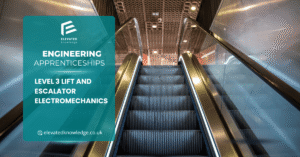
- Route: Engineering Apprenticeship Level 3 Lift and Escalator Electromechanics
- Level: Level 3
- Delivery: In person – Stockport
- Typical duration to gateway: 36 to 42 months
- What it covers: installation or maintenance, repair and modernisation of lifts and escalators
Other related Elevated Knowledge routes and qualifications:
- Level 2 Stairlift, Platform Lift, Service Lift Electromechanics – relevant if you want the smaller-equipment and accessibility side of the sector. Typical duration of 24 months.
- EAL Level 2 Certificate in Lift and Escalator Support Services – relevant if you want a support-services qualification focused on technical skills and knowledge. Typical duration of 18 months.
- EAL Level 2 NVQ Diploma in Engineering Maintenance and Installation: Stairlift, Service Lift, and Platform Lift Pathways – relevant for learners already doing real work on this equipment and needing competence-based assessment. Typical duration of around 18 months.
- EAL Level 3 NVQ Diploma in Engineering Maintenance: Lift and Escalator Pathways – relevant if your work is focused on servicing and repair. Lasts 24 months including EOR course.
- EAL Level 3 NVQ Diploma in Installation and Commissioning: Lift and Escalator Pathways – relevant if your work is focused on installation and commissioning. Typical duration of 24 months including EOR course.
- EAL Level 4 Certificate in Performing Testing Operations in the Lift and Escalator Industry – relevant later in your career if you move into testing or commissioning responsibilities. Remote delivery and a typical duration of 24 months.
Why become a lift engineer?
This is a practical route for learners who want mechanical systems, electrical systems, fault-finding, safety checks and real site work in the same job. Whether it suits you depends on whether you like structured practical work, problem-solving and working to standards.
What might I earn?
Typical lift engineer salaries range from around £22,000 for starter roles up to about £45,000 for more experienced positions. Pay varies by employer, location, overtime, shifts and the type of work you do.
How long does it take to become a lift engineer?
There is no single answer. The current Lift and Escalator Engineering apprenticeship gives a typical duration of 36 months plus a typical 4-month assessment period, while the related Stairlift, Platform Lift and Service Lift pathway has a typical duration of 24 months excluding assessment. Other provider courses and work-based qualifications vary.
What are the working hours and conditions?
Typical working hours for a lift engineer are 40 to 45 hours per week. That work also includes evenings, weekends, bank holidays or shifts, and that lift engineers may work at a client’s business, travel often, and work in cramped or dirty environments.
What happens after I’ve become a qualified lift engineer?
Progression usually comes from time on the job, broader equipment experience, trusted safe working and evidence that you can handle more responsibility.
Experienced lift engineers may move into supervisory management, project management, lift engineering design, technical sales or safety inspection. You can use your skills in the wider building services engineering sector.
In practice, progression can also mean specialising in passenger lifts, stairlifts, service lifts, platform lifts, escalators, moving walks, installation, maintenance, repair, commissioning or testing. Elevated’s Level 4 testing-operations qualification is one example of a later-stage specialist route.
What you’ll learn (learning outcomes)
Learning outcomes vary by route, but the common thread is building repeatable competence so you can work safely and consistently on lift or access equipment. Common learning outcomes include:
- Working safely and preparing the work area
- Reading and using technical information, instructions, diagrams and manuals
- Identifying and checking tools, parts, components and systems
- Setting up equipment correctly
- Carrying out installation, service, adjustment, maintenance or repair tasks to the required standard
- Recognising common safety or quality issues
- Understanding inspection, checking, testing or verification
- Completing records and documentation accurately
Depending on the route, you may also need documented workplace evidence or final external assessment before completion. An apprentice must complete training and meet gateway requirements before EPA, and several related qualifications at Elevated Knowledge are competence-based and assessed through real work activity.
Pay and progression as a professional lift engineer

This section separates two topics that are often mixed together:
- Apprentice pay rules (legal minimums)
- Typical pay for qualified lift engineers (labour market information)
Apprentice pay rules in England
The apprentice rate is £8.00 per hour from 1 April 2026. The apprentice rate applies if you are under 19, or if you are 19 or over and in the first year of your apprenticeship. If you are 19 or over and have completed the first year, you must be paid at least the minimum wage for your age band.
Apprentices get training or study time as part of the apprenticeship, and apprentice training takes place during working hours.
Typical pay and hours for lift engineers
Lift engineers typically earn about £22,000 when starting out and up to around £45,000 when experienced, with working hours commonly around 40 to 45 per week.
These figures are a broad guide, not a guarantee, and real pay varies by location, employer, overtime, call-out work, shifts and specialism.

Frequently asked questions
What is the difference between a lift, an escalator and a moving walkway?
- A lift moves people or goods vertically between levels.
- An escalator is a moving stairway.
- A moving walkway, sometimes called a moving walk, moves people horizontally or on a slight incline using moving pallets rather than steps.
What is the difference between a traction lift, a hydraulic lift and an MRL lift?
At a basic level, these terms describe different lift arrangements. The main difference is how the lift is moved and where the key equipment is housed:
- Traction lift: Uses ropes or belts and a drive system to move the lift car up and down. These are common in many passenger lift installations.
- Hydraulic lift: Uses a hydraulic ram to raise the lift car. These are often used where the travel distance is shorter or where a particular building layout suits a hydraulic system.
- MRL lift: Short for machine-room-less lift. This is usually a type of traction lift where the main machinery is built into the lift shaft rather than placed in a separate machine room.
Because the systems use different equipment layouts and installation methods, they may also have different maintenance and specification requirements.
What is the difference between a service lift, a platform lift and a stairlift?
These are different types of lifting equipment, designed for different uses rather than interchangeable names for the same thing.
- Service lift: Usually used to move goods, food, tools, parts or equipment between levels. It is not normally designed as a standard passenger lift.
- Platform lift: Used to help people move between levels, often where accessibility is needed and a full passenger lift may not be practical.
- Stairlift: Fitted to a staircase to help a person travel up and down the stairs, usually while seated.
Think about them by purpose: service lifts are mainly for goods, platform lifts are often for access between levels, and stairlifts are fitted directly to stairs.
What is the difference between commissioning, maintenance and repair in lift engineering?
Commissioning is bringing newly installed or modernised equipment into service, maintenance is planned servicing and checking, and repair is the work needed when faults, wear or damage have to be corrected.
What do LOLER, PUWER and BS EN 81 mean?
These are common terms in lift engineering, maintenance and safety. They are not the same thing, but they often appear together because lifts are both lifting equipment and work equipment.
- LOLER stands for the Lifting Operations and Lifting Equipment Regulations. In simple terms, it covers the safe use, inspection and thorough examination of lifting equipment.
- PUWER stands for the Provision and Use of Work Equipment Regulations. It covers the safe provision, maintenance and use of work equipment, which can include lifts and related machinery.
- BS EN 81 refers to a family of British and European standards for lifts. Different parts of the standard cover different types of lifts, lifting platforms, safety rules and technical requirements.
LOLER and PUWER are workplace safety regulations, while BS EN 81 is a set of technical standards used to support safe lift design, installation and use.
How do I find lift engineer courses near me in England?
- Search live apprenticeship vacancies using the Find an apprenticeship service.
- For college or training routes, use the National Careers Service job profile and course search tools, then compare provider pages for delivery, duration and pathway focus.
What to ask when comparing lift engineering training courses
Ask practical questions such as:
- What will I actually practice?
- How much supervised practical time is included?
- What safety training is built in?
- How is quality checked?
- What qualification, certificate or evidence will I leave with?
- If this is an apprenticeship or work-based route, what evidence will I need for gateway, EPA or workplace assessment?
Do I need English and maths for a lift engineer apprenticeship in England?
It depends on your age, existing qualifications and the apprenticeship route you start.
For apprenticeships in England, English and maths requirements are linked to the apprenticeship funding rules. Some learners may need to work towards approved English or maths qualifications as part of their training, especially if they do not already have suitable equivalent qualifications.
For lift-related apprenticeships, the exact requirement can depend on the standard. For example, a stairlift, platform lift or service lift route may set different English and maths expectations from a lift and escalator engineering route.
In practice, your training provider or employer should check your existing qualifications before you start and confirm what, if anything, you need to complete before your end-point assessment.
What is an apprenticeship EPA, and when does it happen?
EPA stands for end-point assessment. It is the final assessment stage of an apprenticeship and takes place after the apprentice has completed their training and met the required gateway checks.
The EPA is used to confirm whether the apprentice can demonstrate the knowledge, skills and behaviours needed for the occupation. For a lift and escalator engineering apprenticeship, this may include practical skills, technical understanding, safe working and evidence from the apprentice’s training.
Simply put, the EPA is the point where the apprentice shows they are ready to be assessed against the occupational standard, rather than just continuing through training.
What PPE do lift engineers usually need?
The exact personal protective equipment, or PPE, depends on the task, site rules and risk assessment. A lift engineer may need different PPE for installation, maintenance, repair, inspection or working in a lift shaft.
Common examples can include:
- Safety helmet: to help protect against head injury.
- Gloves: to protect hands when handling tools, parts or materials.
- Eye protection: where there is a risk from dust, debris, sparks or flying particles.
- Hearing protection: where noise levels are high.
- High-visibility clothing: especially on construction sites or shared work areas.
- Safety footwear: to protect feet from impact, slips or sharp objects.
- Fall protection equipment: such as a harness, where there is a risk of falling from height.
- Respiratory protective equipment: where there may be exposure to dust, fumes, mist, gas or other airborne hazards.
PPE should be chosen for the specific job, not treated as a one-size-fits-all checklist. Your employer or site supervisor should confirm what is needed before work starts.
What should I do next if I want to become a lift engineer?
A sensible next step is to:
- Choose the route that fits your situation.
- Check apprenticeship vacancies, course options and provider details in England.
- Compare what each route actually teaches.
- Ask how practical training and safety are handled.
- Work out what evidence you will be able to show an employer at the end.
Do lift engineers usually work in one place or travel between jobs?
Lift engineers often travel between different sites rather than working in one fixed location every day. The exact pattern depends on the employer, the type of work and the contracts being covered.
Some jobs may involve working at a client’s premises, such as an office, factory, hospital, shopping centre or residential building. Other roles may involve travelling across a local area, region or wider part of the country, especially for commercial or industrial lift work.
In practice, lift engineering can be a mobile role. Apprentices and new starters should expect that travel, site visits and changing work locations may be part of the job.
Sources used in this article
- https://www.gov.uk/government/publications/english-and-maths-requirements-in-apprenticeship-standards-at-level-2-and-above/english-and-maths-requirements-in-apprenticeships-guidance
GOV.UK – English and maths requirements in apprenticeships in England.
Published: 4 May 2020.
Last updated: 19 February 2026.- https://www.gov.uk/become-apprentice
GOV.UK – Become an apprentice: how apprenticeships work in England, including basic eligibility.- https://www.gov.uk/apply-apprenticeship
GOV.UK – Find an apprenticeship: where to search and apply.- https://www.gov.uk/become-apprentice/pay-and-conditions
GOV.UK – What apprentices get, including pay, training time and employee rights.- https://www.gov.uk/employing-an-apprentice/pay-and-conditions-for-apprentices
GOV.UK – Apprentice pay rules and how age and year of apprenticeship affect pay.- https://www.gov.uk/national-minimum-wage-rates
GOV.UK – Current National Minimum Wage and apprentice rate from 1 April 2026.- https://nationalcareers.service.gov.uk/job-profiles/lift-engineer
National Careers Service – lift engineer job profile, entry routes, day-to-day tasks, hours, pay and progression.- https://skillsengland.education.gov.uk/apprenticeships/st0252-v1-2
Skills England – Lift and Escalator Engineering apprenticeship summary.- https://skillsengland.education.gov.uk/apprenticeships/st0252-v1-2?view=epa
Skills England – Lift and Escalator Engineering EPA summary and gateway wording.- https://skillsengland.education.gov.uk/apprenticeship-standards/st0251-v1-1
Skills England – Stairlift, Platform Lift, Service Lift Electromechanic apprenticeship summary.- https://www.apprenticeships.gov.uk/apprentices/off-the-job
Apprenticeships – off-the-job training guidance for apprentices.- https://findapprenticeshiptraining.apprenticeships.education.gov.uk/courses
Find apprenticeship training – course and provider search in England.- https://www.hse.gov.uk/work-equipment-machinery/passenger-lifts.htm
HSE – passenger lifts and escalators guidance.- https://www.hse.gov.uk/work-equipment-machinery/loler-overview.htm
HSE – LOLER overview.- https://www.hse.gov.uk/work-equipment-machinery/puwer-overview.htm
HSE – PUWER overview.- https://www.hse.gov.uk/ppe/overview.htm
HSE – overview of PPE at work.- https://www.hse.gov.uk/safetybulletins/platform-lifts.htm
HSE – platform lift safety bulletin referencing BS EN 81 standards.- https://www.hse.gov.uk/safetybulletins/service-lifts-in-offshore-onshore-turbines.htm
HSE – service-lift safety bulletin referencing BS EN 81-44.Last reviewed: 22 April 2026